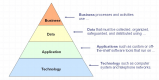
Enterprise Architecture Overview Training Course
This course is designed for all professionals engaged in the planning, analysis, implementation, execution, maintenance, and enhancement of Enterprise Architectures. It provides a comprehensive perspective on the tools utilized to describe and implement EA.
This course is available as onsite live training in United Arab Emirates or online live training.Course Outline
Introduction to Enterprise Architecture
- Understanding Architecture
- Enterprise Architecture (EA)
- The Necessity of EA
- IT Enterprise Architecture
- Business Enterprise Architecture
- EA Description vs. EA Implementation
Enterprise Architecture Methods, Frameworks, Concepts, and Paradigms
EA, Governance, and Strategic Planning
- Strategic Management and Planning
- OMG Business Motivation Model
- Strategy Execution (EFQM)
- Quality Management (Six Sigma, TQM, ISO 9001)
- IT Governance
- IT Service Delivery and Support (ITIL)
- IT Implementation (CMM and CMMI)
Methods and Frameworks
- IEEE Standards
- Zachman Framework
- OMG UAF (Unified Architecture Framework)
- MDA
- SOA
- NATO Architecture Framework, MoDAF, DoDAF, UPDM
Description Languages
- IDEF
- BPMN
- Testbed
- SoaML
- UML
- Architecture Description Languages
- Suitability for EA
Enterprise Architecture Modelling
- Modelling Process
- Readability and Usability of Models
- Viewpoints and Visualisation
Architecture Analysis
- Analysis Techniques
- Quantitative Analysis
- Functional Analysis
Other Topics
- Architecture Alignment
- Tool Support
Need help picking the right course?
Enterprise Architecture Overview Training Course - Enquiry
Testimonials (1)
In my opinion large amount of practical examples is very helpful to understand subject.
Pawel - EY GDS (CS) Poland Sp. z o.o.
Course - ITIL® Foundation V4
Upcoming Courses
Related Courses
Architecture of Distributed and Highly Scalable Systems
21 HoursThis instructor-led, live training in the UAE (online or onsite) is aimed at intermediate-level to advanced-level software professionals who wish to understand how to architect distributed systems that scale efficiently and handle failure gracefully.
By the end of this training, participants will be able to:
- Design distributed systems that handle load, latency, and failure.
- Understand key architectural patterns such as microservices, event-driven architecture, and CQRS.
- Evaluate trade-offs between consistency, availability, and partition tolerance (CAP theorem).
- Choose appropriate communication, storage, and coordination strategies.
Introduction to Domain Driven Design
14 HoursDomain-Driven Design (DDD) is a strategic approach designed to manage complexity in software development by focusing on core business domains.
Introduction to Enterprise Architect
7 HoursThis introductory training course on Enterprise Architect is tailored for individuals looking to utilize Sparx Systems’ UML modeling tool, Enterprise Architect, for their modeling tasks, but who are not yet familiar with its features, functions, or usage.
Enterprise Architecture in the UAF
35 HoursThrough a blend of lectures, demonstrations, and hands-on interactive labs, this course illustrates the foundational principles required to build and sustain an Enterprise Architecture (EA) using the Unified Architecture Framework (UAF) version 1.2.
ITIL® 5 Foundation Bridge – Accredited Training with Certification Exam
7 Hours
This training is tailored for professionals who already hold an ITIL® 4 Foundation certification and wish to update their expertise to the latest ITIL® 5 framework.
It offers a streamlined and effective transition, emphasizing the core differences, new concepts, and expanded practices introduced in ITIL® 5.
ITIL®️ 4 Practice Manager
21 HoursDefined as "a set of organizational resources for performing work or accomplishing an objective," there are 34 ITIL management practices in total, representing some of the most practical resources in the ITIL framework.
Whereas ITIL 4 Foundation introduces the management practices as concepts, the hands-on learning, and steps to apply the concepts happens in the practice modules. Validation of those skills happens with certification. Each individual practice course is intended for professionals who want to prove and validate their skills in specific practice areas, but certification as a Practice Manager requires a broader set of skills within a minimum of 5 practices that fall within three management practice domains:
- Monitor, Support, and Fulfill
- Plan, Implement, and Control
- Collaborate, Assure, and Improve
If you are an IT Professional interested in achieving the Practice Manager qualification, then you are seeking to establish good cross-practice collaboration and effective service value streams in your organization. To do this you must complete any 5 individual practices plus the ITIL Specialist: Create, Deliver and Support module, or you must complete one of the 3-day domain-based bundles plus the ITIL Specialist: Create, Deliver and Support module.
ITIL® Foundation V4
14 HoursThis program is tailored for anyone seeking a solid grasp of IT Service Management to help drive greater value for customers. It is ideal for IT personnel and managers at all levels, as well as clients who collaborate closely with IT to meet business objectives. Additionally, this course supports students preparing for the ITIL® 4 Foundation certification and the associated exam.
The ITIL 4® Foundation equips candidates with an end-to-end operating model to create, deliver, and continuously improve tech-enabled products and services.
ITIL 4® Foundation empowers candidates to:
- Adopt a holistic approach to co-creating value with customers and stakeholders through products and services
- Understand the guiding principles of ITIL 4®
- Comprehend the four dimensions of Service Management
- Explore key concepts from Lean, Agile, and DevOps, and their role in delivering business value
- Learn how ITIL 4® practices preserve the value of current ITIL® processes while integrating them into broader service management and IT areas, from demand to value
Who is ITIL 4® Foundation for:
ITIL 4® Foundation is suitable for individuals needing a foundational understanding of the ITIL® framework and how it can enhance IT service management quality within an organization. It is also relevant for IT professionals in organizations that have adopted ITIL® and need to contribute to overall service improvement initiatives.
ITIL 4® continues to support the ITSM community while expanding to a wider range of professionals in the digital world, guiding how IT interfaces with and leads broader business strategy.
ITIL® Foundation V5
14 HoursThis training offers a comprehensive introduction to ITIL® 5, the contemporary framework designed for managing digital products and services within today's rapidly evolving business landscapes. Participants will gain a robust understanding of how organizations can generate value through effective service management and collaborative efforts.
ITSM Fundamentals (ITIL 4-Based)
14 HoursThis instructor-led, live training in the UAE (online or onsite) is designed for intermediate-level IT professionals and ICT service managers who wish to understand and apply ITSM fundamentals and practices based on ITIL 4.
By the end of this training, participants will be able to:
- Understand key concepts and structure of ITIL 4.
- Apply service design and architecture practices aligned with ITIL 4 principles.
- Implement effective delivery and sustainability of ICT services.
- Evaluate real-world cases and simulate ITSM practices.
OCSMP Model Builder - Fundamentals prep
21 HoursThe OCSMP Model Builder – Fundamental certification assesses the knowledge and competencies needed to create a foundational SysML model for a system. The exam evaluates understanding of model concepts and organization, fundamental requirements capture and management, structure and behavior modeling, parametric models, allocation relationships, and the application of stereotypes. With the skills acquired at this level, along with proficiency in a compatible SysML modeling tool, a certified professional can effectively contribute to modeling activities undertaken by Systems Engineering teams utilizing a model-based systems engineering approach with SysML. The OCSMP Model Builder – Fundamental Certification serves as a prerequisite for the program’s two advanced levels and requires the OCSMP Model User Certification as its entry requirement.
This examination (along with other assessments in the OCSMP series) evaluates your ability to apply the listed knowledge and skills within the context of a system model. During your preparation, look beyond individual diagrams to grasp how elements modeled in one diagram can influence or impact aspects of the system depicted in other diagram types.
Systems Modeling with SysML and Enterprise Architect (EA)
21 HoursIn this instructor-led live training in the UAE (online or onsite), participants will learn how to employ SysML as implemented in Enterprise Architect (EA) to perform system requirements analysis and modeling.
By the end of this training, participants will be able to:
- Understand and apply SysML to Systems Engineering projects, adopting a Model Based Systems Engineering (MBSE) approach.
- Identify system requirements based on use case models.
- Design and analyze system architecture.
SysML by example
21 HoursThis hands-on training program demonstrates how to effectively utilize the SysML modeling language. Participants will explore block diagrams for the structural modeling of complex systems and deepen their understanding of sequence diagrams, state diagrams, and activity diagrams for dynamic modeling. The course also covers specific SysML diagrams, including requirements and parametric diagrams, alongside the critical concept of allocation. Attention is given to establishing a modeling approach tailored to an organization’s context and the nature of the systems under study. Finally, the session reviews the current landscape of SysML modeling tools.
Audience:
Project managers, architects, and system engineers who need to model complex systems comprising both software and hardware components.
Teaching Method:
- Theoretical presentations supported by practical examples
- Hands-on case study exercises (with trainer-led demonstrations of SysML tools)
UML in Enterprise Architect (workshops)
21 HoursThis course is tailored for analysts, designers, developers, testers, and project managers.
The workshop covers problem analysis, system design, and documentation using UML and Sparx Systems' Enterprise Architect. Participants will explore the software's advanced capabilities—such as MDA, profiles, and XMI—along with best practices that significantly streamline and accelerate the modeling process.
As the training focuses on the Enterprise Architect tool, participants are expected to already possess UML modeling knowledge. For those wishing to learn modeling fundamentals, we offer dedicated UML training courses.
Training Methodology
10% Lecture, 90% Workshop
Use Case Modeling
14 HoursThis course is tailored for business analysts, managers, team leaders, and process owners to equip them with the essential skills needed to create use case diagrams and scenarios. These tools act as a vital medium for eliciting, analyzing, documenting, and communicating functional requirements. Participants will gain hands-on experience in crafting use cases using the Unified Modeling Language (UML) to visually depict the interactions between use cases and actors.